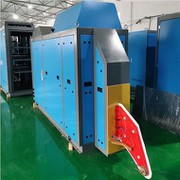
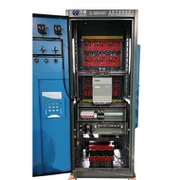
What is Induction Heating Equipment
Jan 07, 2022
Induction heating equipment is a kind of three-phase power frequency alternating current, which is rectified into direct current, and then the direct current is converted into an adjustable current, which supplies the alternating current flowing through the capacitor and the induction coil, and generates high density in the induction coil. The magnetic line of force is cut, and the metal material contained in the induction coil is cut, resulting in a large eddy current in the metal material.
Induction heating equipment
This eddy current also has some properties of intermediate frequency current, that is, the free electrons of the metal itself flow in the metal body with resistance to generate heat. For example, if a metal cylinder is placed in an induction coil with alternating intermediate frequency current, the metal cylinder is not in direct contact with the induction coil, and the temperature of the energized coil itself is very low, but the surface of the cylinder is heated to the point of redness or even melting , and the speed of this redness and melting can be achieved as long as the frequency and the strength of the current are adjusted. If the cylinder is placed in the center of the coil, the temperature around the cylinder will be the same, and the heating and melting of the cylinder will not produce harmful gases or pollute the environment with strong light.
All solid state induction heating power supply
All-solid-state induction heating power supply refers to the induction heating power supply with various power transistors, such as MOSFET, IGBT and other power devices, also called modern induction heating power supply. The "solid state" induction heating power supply is for the teacher thyristor and vacuum tube induction heating power supply. It has the advantages of small power supply, low loss, high inverter conversion efficiency, easy operation and control, and safety and performance.
The all-solid-state induction heating power supply has the following characteristics:
1) The basic theory of the circuit has not changed much. Due to the use of new power devices, the circuit and implementation technology have been greatly developed;
2) Most of the power rectifier and inverter circuit devices use module devices instead of single power devices. In order to achieve greater power, series, parallel or series-parallel connection of power devices is used;
3) A large number of digital integrated circuits and special integrated circuits are used in the control circuit and protection circuit, which simplifies the design of the circuit and improves the reliability of the system;
4) New circuit components, such as non-inductive capacitor modules, non-inductive resistors, application of power ferrite, etc.;
5) Wide frequency range, from 0.1--400kHz covering the range of intermediate frequency, high frequency and super audio frequency;
6) High conversion efficiency and obvious energy saving. The load power factor of the transistor inverter can be close to 1, which can reduce the input power by 22%--30%) and reduce the cooling water consumption by 44%--70%;
7) The whole device has a compact structure, which can save 66%--84% of the space compared with the electronic tube equipment;
8) Perfect protection circuit and high reliability;
9) Inside the power supply, there is no high voltage at the output end, and the safety is high.
This equipment is widely used in welding, annealing, quenching, diathermy and other processes, covering automobiles, motorcycle parts, railway rails, aerospace, weapon manufacturing, machinery manufacturing, electrical manufacturing and special metal processing industries. Heat penetration before die forging, quenching and annealing of workpiece surface and local parts, brazing of motors, electrical appliances and valves, sintering of tungsten, molybdenum and copper-tungsten alloys, and melting of metals such as gold and silver.
Main application areas
(1) Welding
1. Welding of diamond heads, welding of carbide saw blades and welding of diamond tools, abrasive tools and drilling tools.
2. Welding of cemented carbide tools for machining. Welding of cutting tools such as turning tools, planers, milling cutters, reamers, etc.
3. Welding of mining tools, such as "one" bit, column tooth bit, dovetail briquette bit, riveting rod bit, welding of various shearer picks and various roadheader picks.
4. Welding of various woodworking tools, such as welding of various woodworking planers, milling cutters and various woodworking drills.
(2) Forging and rolling
1. The steel plate is heated and bent.
2. Standard parts, diathermy forming of fasteners.
3. Heat diathermy for hardware tools, such as pliers, wrenches, etc.
4. Extrusion of the taper shank of the prospecting drill rod.
5, steel pipe diathermy forming such as elbow and so on.
6. Heat annealing of metal materials. Such as: copper pipe, steel pipe stretching, pipe bending, head smashing; iron wire, steel wire heating nailing; stainless steel products annealing, expanding.
7. Hot-loading of automobile rear axle, hot-loading of motor rotors, bearings, gears and other workpieces;
(3) Heat treatment
1. Heat treatment of various hardware tools and hand tools. Such as pliers, wrenches, screwdrivers, hammers, axes, etc.
2. High-frequency quenching treatment of various auto parts and motorcycle parts. Such as: crankshaft, connecting rod, piston pin, crank pin, sprocket, camshaft, valve, various rocker arms, rocker arm shaft; various gears in the gearbox, spline shafts, transmission half shafts, various small shafts , All kinds of forks and other high-frequency quenching treatment.
3. High-frequency quenching treatment of gears, shafts, etc. on various power tools.
4. Heat treatment for high frequency quenching of various hydraulic components and pneumatic components. Such as the column of a plunger pump.
5. Quenching treatment of plugs, rotors of rotor pumps; reversing shafts on various valves, gears of gear pumps, etc.
6. Heat treatment of metal parts. Such as high-frequency quenching treatment of various gears, sprockets, various shafts, spline shafts, pins, etc.
7. Quenching treatment of machine tool bed guide rails in the machine tool industry.