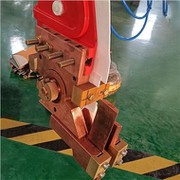
Reasons and solutions for affecting the shape of workpiece during quenching
Jan 19, 2022
In quenching, due to the shape of the quenched workpiece, affecting the quality and process of quenching is one of the technical difficulties we often encounter when using high-frequency quenching machines. Under normal circumstances, it may be related to the following 7 points, as follows:
1. The shape is particularly complex
When the shape is particularly complex or different parts have different performance requirements, it can be changed to a combined structure if conditions permit. For long and large pieces, we need to consider clamping and hanging for heat treatment when designing. Those particularly thin, long and slender parts should be spliced as much as possible when they may need to be spliced structurally.
2. Quenching
Gears with spline holes and their sleeves, teeth or outer circles need to be quenched by a high-frequency quenching machine, and the minimum size of its wall thickness should be limited, so as to avoid excessive deformation.
3. Shaft parts
Please try to shorten the ratio of slender shaft parts as much as possible, improve the rigidity of the part structure, and add reinforcing ribs when necessary.
4. Part geometry
The geometric design of parts should be reasonable in shape, and should be simple and symmetrical.
5. Parts section
Try to make the section of the part uniform and the quality balanced. When necessary, technological grooves or technological holes can be added, and the number and position thereof can be reasonably distributed.
6. Slots or holes
Slots or holes should be avoided as much as possible. For unavoidable holes or slots, the edges must be chamfered. The sharp corners should be blunt or rounded. The keyway can be chamfered at the arcs at both ends of the slot.
7. Concave-convex groove and its inner hole
If possible, it can be drilled laterally through the bottom of the inner hole, which is beneficial to improve the cooling conditions of the inner hole during quenching by the high frequency quenching machine.
When the inner hole and concave-convex groove require hardening, the strain-free through hole is a through hole. There should be a certain distance between holes and edges or between holes and holes.